
In the age of short-form video, children’s attention is being “stolen.”

Many parents feel confused: what’s happening to their child?
“Before, my child could sit quietly and finish a whole book. Now, after a few pages, they reach for their phone.”
“Teachers say my child often zones out in class and starts daydreaming after working for a short time.”
“When watching short videos, they’re extremely focused—but when it’s time to study, they suddenly need to go to the bathroom, drink water, or look for an eraser.”
If this sounds familiar, your child may be facing a modern challenge: declining attention span.
This is not your child’s fault, and it’s not due to poor parenting. The way short-form videos reshape attention is scientifically proven.
Short-form content is changing children’s brains
A 2023 study published in The Lancet Digital Health [1] found that adolescents who use social media for more than 3 hours per day have a 30% higher risk of developing attention deficit symptoms.

Why do short videos harm attention so much?
1. High-frequency stimulation “resets” the brain
Short videos switch content every 5–15 seconds, keeping the brain in a constant loop of “novelty → reward → seeking the next novelty.” Once the stimulation stops, dopamine levels drop rapidly, making it difficult for children to stay engaged with slower-paced activities like studying.
2. Passive consumption replaces active thinking
When scrolling through videos, the brain requires almost no cognitive effort. In contrast, learning demands sustained attention, resource allocation, and self-control. Without regular use, these abilities gradually weaken and decline.
3. Risk to prefrontal cortex development
A neuroimaging study from Harvard University [2] found that prolonged exposure to highly stimulating content is associated with a measurable decrease in gray matter density in the prefrontal cortex—the area responsible for planning, focus, and self-control. Since the prefrontal cortex does not fully mature until around age 25, children and adolescents are especially vulnerable to these effects.

This is why many parents realize: it’s not that children don’t want to study—it’s that they “can’t focus anymore.” Their brains have adapted to high stimulation and lost patience for low-stimulation tasks like learning.
A new scientific, non-drug approach — Near-Infrared Light (NIR)
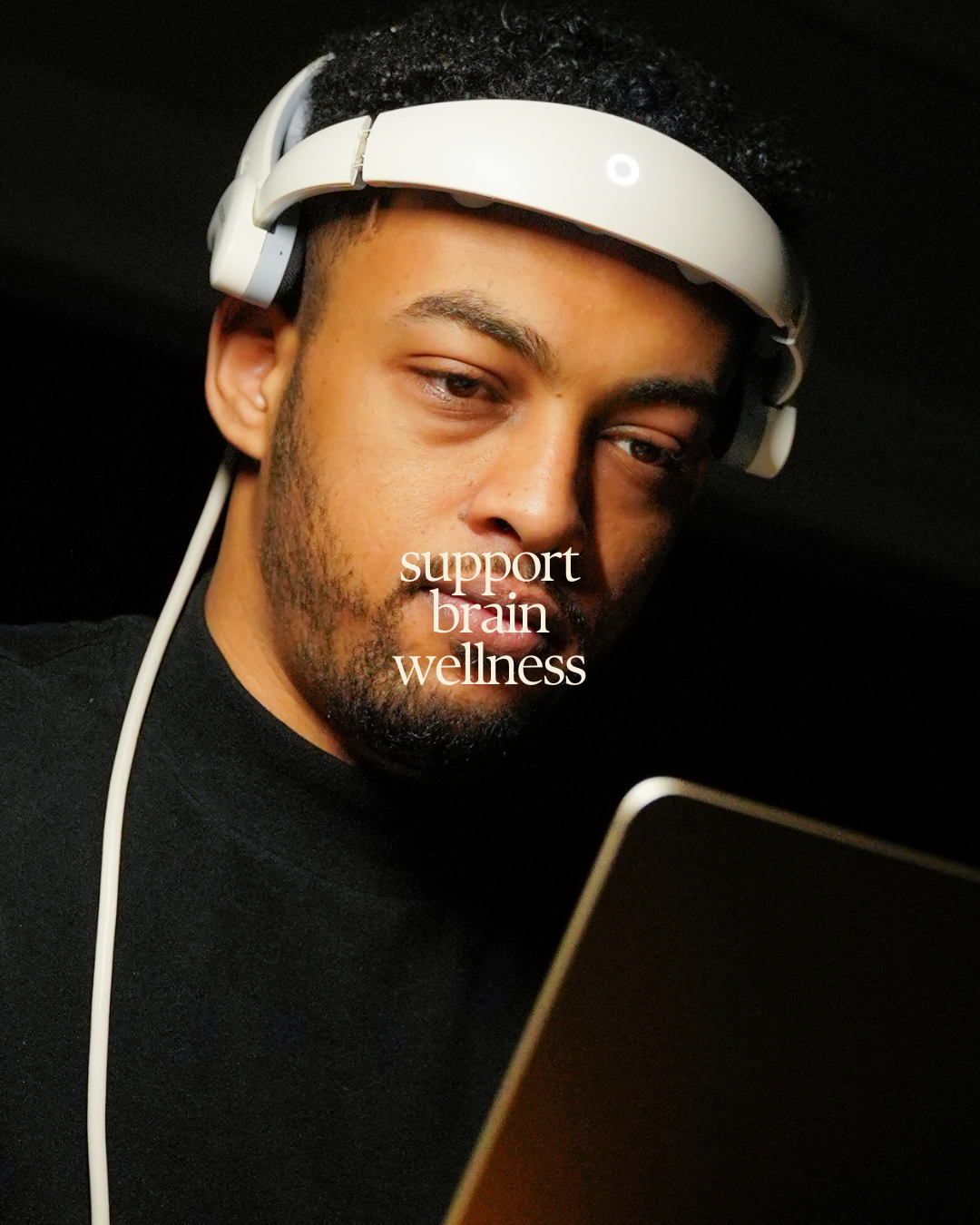
In recent years, a technology called near-infrared light therapy (NIR) has shown potential in improving attention.
How does it work?

1. Photobiomodulation effect
Near-infrared light at specific wavelengths (600–1100 nm) can penetrate the scalp and skull to reach the brain cortex. Once absorbed by the mitochondria inside cells, it stimulates the production of ATP (the cell’s energy currency) and improves the metabolic function of neurons [3].
2. Increased cerebral blood flow
Multiple studies [4] have shown that after near-infrared light exposure, oxygen levels in the prefrontal cortex significantly increase. Greater blood flow means more nutrient delivery and more efficient waste removal, helping the brain function more effectively.
3. Regulation of neurotransmitters
Preliminary studies [5] suggest that near-infrared light may influence the release of dopamine and norepinephrine—two key neurotransmitters responsible for maintaining attention and alertness.
Clinical evidence
A randomized controlled trial published in a Nature sub-journal in 2020 [6] found that after transcranial near-infrared light stimulation, adult participants showed significant improvements in sustained attention test scores.
A small-scale study in 2022 involving children with ADHD [7] showed that after 4 weeks of near-infrared light intervention, parent-reported attention problems decreased by approximately 25%.
Multi-center clinical trials are also underway domestically, with promising preliminary results.
For example, a near-infrared transcranial device, Brainlume, jointly developed by research teams including PhD researchers from the Academy of Military Medical Sciences, Harbin Institute of Technology, and the Beijing Brain Science team, has shown notable clinical feedback in improving sleep, mood, and attention in adolescents.

For parents who prefer not to use medication for their children, this can be a worth considering adjunctive intervention. Of course, any intervention should be carried out under professional guidance.
Of course, this technology is still in the early research stage and is not a “miracle cure,” but it offers a non-drug, non-invasive approach for supportive intervention.
What else can parents do?
If you are concerned about your child’s attention, here are some recommendations:
1. Reduce exposure to high-stimulation content
- Limit short videos and entertainment-based games to no more than 30 minutes per day
- The younger the child, the stricter the control should be
- Choose activities that require both hands-on engagement and thinking
2. Protect limited attention resources
- Turn off phones/TV during study time
- Create a low-distraction environment
- Use the Pomodoro technique (25 minutes focus + 5 minutes break) to train attention rhythm
3. Pay attention to sleep and exercise
- Lack of sleep can severely impair attention
- Ensure at least 1 hour of outdoor activity daily; natural light helps regulate brain rhythms
4. Consider scientific interventions
- If attention issues are already affecting daily learning and life, seek professional evaluation first
- In recent years, home-use near-infrared devices have emerged—choose reputable brands and pay attention to safety certifications
- Any intervention should be conducted under professional guidance
Final thoughts
We live in an era where attention is constantly being competed for. Short videos are not inherently harmful, but they are subtly reshaping children’s brains in ways that are easy to overlook.
As parents, there is no need to panic—but there is a need to stay aware. Grades can wait, but once the critical window for attention development is missed, it is much harder to recover.
Protecting a child’s attention is giving them a ticket to a freer future.
References:
[1] Lancet Digital Health, 2023
[2] Harvard Neuroimaging Lab, 2022
[3] Hamblin MR. Photobiomodulation. Nature, 2016
[4] Ferraro et al. NIR and cerebral blood flow. NeuroImage, 2020
[5] Blanco et al. Photobiomodulation and neurotransmitters. PBJ, 2019
[6] Chan et al. Nature Translational Psychiatry, 2020
[7] Martinez et al. NIR in ADHD children. J Atten Disord, 2022


Compartir: