
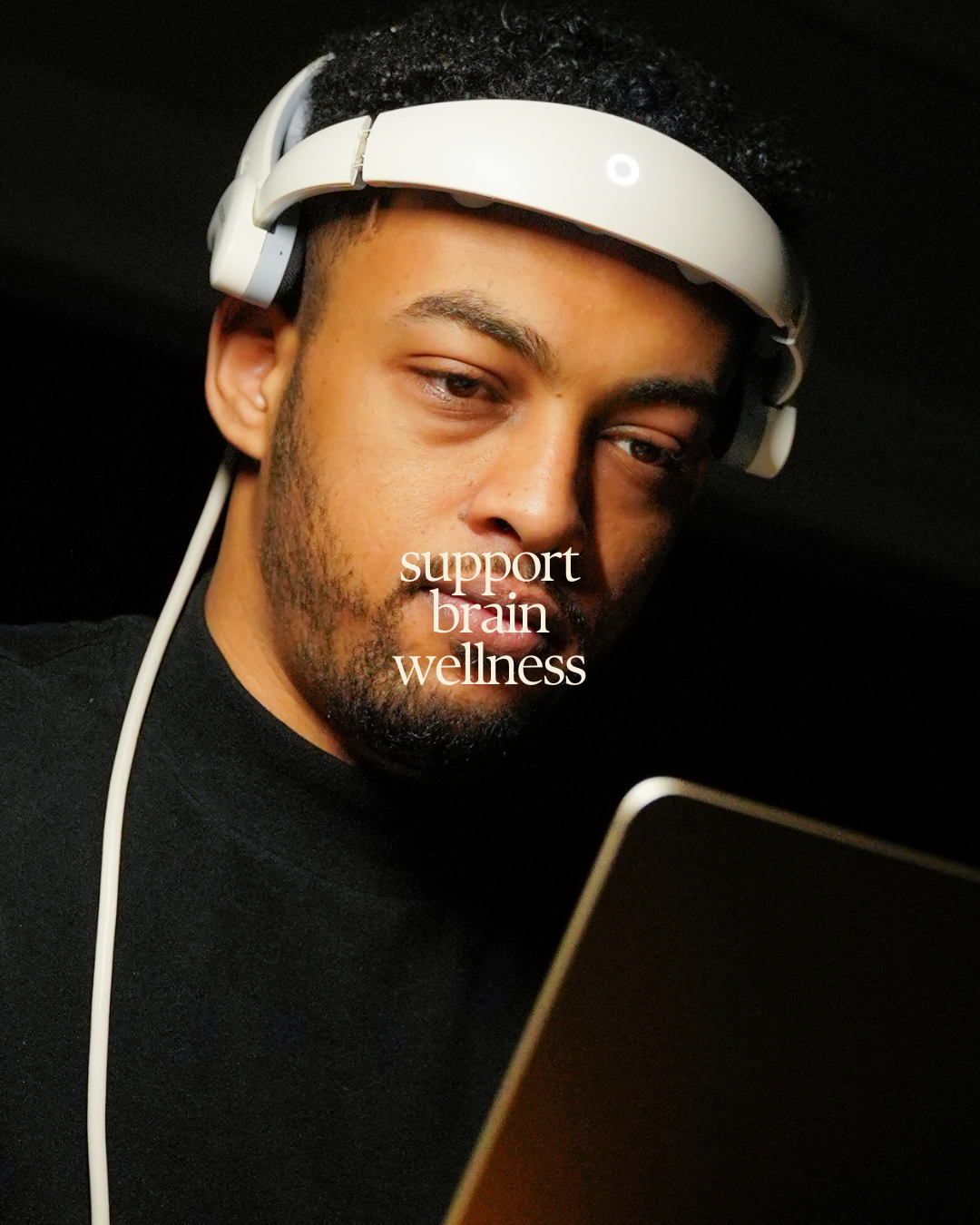
Photons Entering the Brain: Overcoming Three Barriers to Enable Non-Invasive Deep Brain Modulation
Core idea: Using near-infrared light to regulate brain activity faces a major challenge — light has difficulty penetrating into the brain. The skull blocks it, blood absorbs it, and brain tissue scatters and weakens it. Scientists are developing several advanced technologies to overcome these barriers, allowing light to reach deeper brain regions without damaging tissue, with potential applications in treating neurological conditions and supporting brain function.
Key concept: The goal is non-invasive deep-brain photomodulation, enabling light to pass through the three major barriers — the skull, blood, and brain tissue. Emerging approaches being studied include ultrasound-assisted techniques, nano-scale optical technologies, and genetically targeted light sensitivity, and early experimental and clinical studies are already exploring their potential.
The First Barrier: The Skull
The skull acts as a strong physical barrier, and historically more than 90% of incoming light is reflected or absorbed before reaching the brain. Overcoming this “protective wall” is the first major challenge researchers must address when developing light-based brain technologies.

The skull is dense and rigid, which causes strong light scattering when light is applied, making it difficult for photons to reach the brain tissue. Researchers are currently exploring two main approaches to address this challenge.
One approach involves ultrasound-assisted “temporary windows.” By using focused ultrasound (around 0.5 MHz) at specific points on the skull for a very short duration, scientists can create a temporary change in the skull’s acoustic and structural properties. This may reduce light scattering and allow near-infrared light (around 810 nm) to penetrate more effectively into deeper tissues. Experimental studies suggest that this technique could significantly improve light transmission through the skull.
Another approach is the use of transparent cranial implants. These implants are made from specially engineered materials, such as photonic crystal structures using titanium dioxide and silicon, designed to allow near-infrared wavelengths (approximately 700–1100 nm) to pass through efficiently. Some designs use biodegradable magnesium alloy supports, which may gradually integrate with natural bone over time, reducing the need for additional surgery. These concepts have been explored in experimental models and may support future developments in optical brain research.
The Second Barrier: Avoiding the “Absorption Trap” of Blood (Hemoglobin Strongly Absorbs Light)

The brain contains many blood vessels, and hemoglobin—whether oxygenated or deoxygenated—strongly absorbs near-infrared light. As a result, the light can be absorbed by blood before it even reaches the neurons.
The solution is straightforward: follow the pulse and “find the gap.” Using fMRI to monitor arterial pulsation in real time, light pulses are delivered during the cardiac relaxation phase, when blood volume in the vessels is at its lowest. It’s like crossing the street during a break in traffic—the light can pass through the blood more easily. This approach can increase the light flux reaching the prefrontal cortex by three times (reported in a 2025 Journal of Biomedical Optics study).
Another method is blood oxygen modulation, which temporarily adjusts the oxygenation state of the blood to reduce light absorption and “clear the way” for the light (the principle is similar—reducing the blocking effect of blood on light).
The Third Barrier: Solving Tissue Heat Dissipation(If the light is too strong, it can overheat the brain; if it is too weak, it has little effect.)

When light passes through tissue, it generates heat. If the power is too high, it can damage the brain; if it is too low, it will not produce a regulatory effect. Researchers are now using nanotechnology to precisely control light.
Nano “light-focusing antennas”: Graphene quantum dots are used to create plasmon resonance on their surface, which can amplify the light field intensity by 100 times. This means that only 1 mW/cm² of low-power light (about one ten-thousandth of the power of a smartphone flash) is needed to produce a strong local optical signal. In addition, the quantum dots can be modified with Angiopep-2 peptides, allowing them to cross the blood–brain barrier and accumulate around neurons, preventing energy waste.
Nano “light converters”: Scientists have developed core–shell nanoparticles called NaYF₄:Yb³⁺/Tm³⁺. These particles can absorb highly penetrating 975 nm light (which can travel through up to 8 cm of tissue) and convert it inside the brain into 810 nm light, which is more effective. This is like installing a “mini signal lamp” deep in the brain that delivers light directly to neurons.
Advanced Approach: Making the Brain “More Sensitive” to Light (Biological Adaptation)
Getting light into the brain is not enough—the neurons also need to be more sensitive to light for stronger effects.
Gene modification “boost”: Viral vectors can deliver a ChR2-CCO fusion gene into neurons, allowing them to express special light-sensitive proteins. This can increase neuronal sensitivity to light by up to 1000 times (reported in Science, 2023). It is like installing a “light sensor” in neurons, so even a small amount of light can trigger a response.
Implanted micro light-guide networks: Injectable hydrogel conduits can be implanted in the brain and expand into a tiny optical network. Each square millimeter contains 50 light-emitting points, with a spatial resolution of about 20 micrometers (thinner than a human hair). This allows precise activation of dendritic spines—key sites of neural connections—without affecting nearby cells.
Future Outlook: Technology Roadmap
- 2023: Ultrasound transparent windows successfully tested in animal experiments.
- 2024: Quantum-dot nano antennas enter Phase I clinical trials to test safety in humans.
- 2025: Biodegradable photonic skull implants approved for clinical use.
- 2026: Vascular optical conduits expected to be used in the treatment of Parkinson’s disease.
Summary
The scientific breakthrough can be understood as a three-dimensional solution:
- Physical level: Using ultrasound and photonic crystals to improve light penetration.
- Biological level: Using gene modification and nanoparticles to increase the brain’s sensitivity to light.
- Control level: Delivering light in synchronization with the pulse to use precise time windows.
Together, these approaches allow photons to overcome the three major barriers—skull, blood, and tissue—making it possible to modulate deep brain activity without damaging the brain, opening new directions for both medical treatment and cognitive enhancement.


Share:
Mechanism 4: Neural Oscillation Regulation — How Light May Enhance Focus and Memory Light...
Mechanism 3: BDNF and Plasticity Reconstruction — Why Light Can Promote Neural Repair