
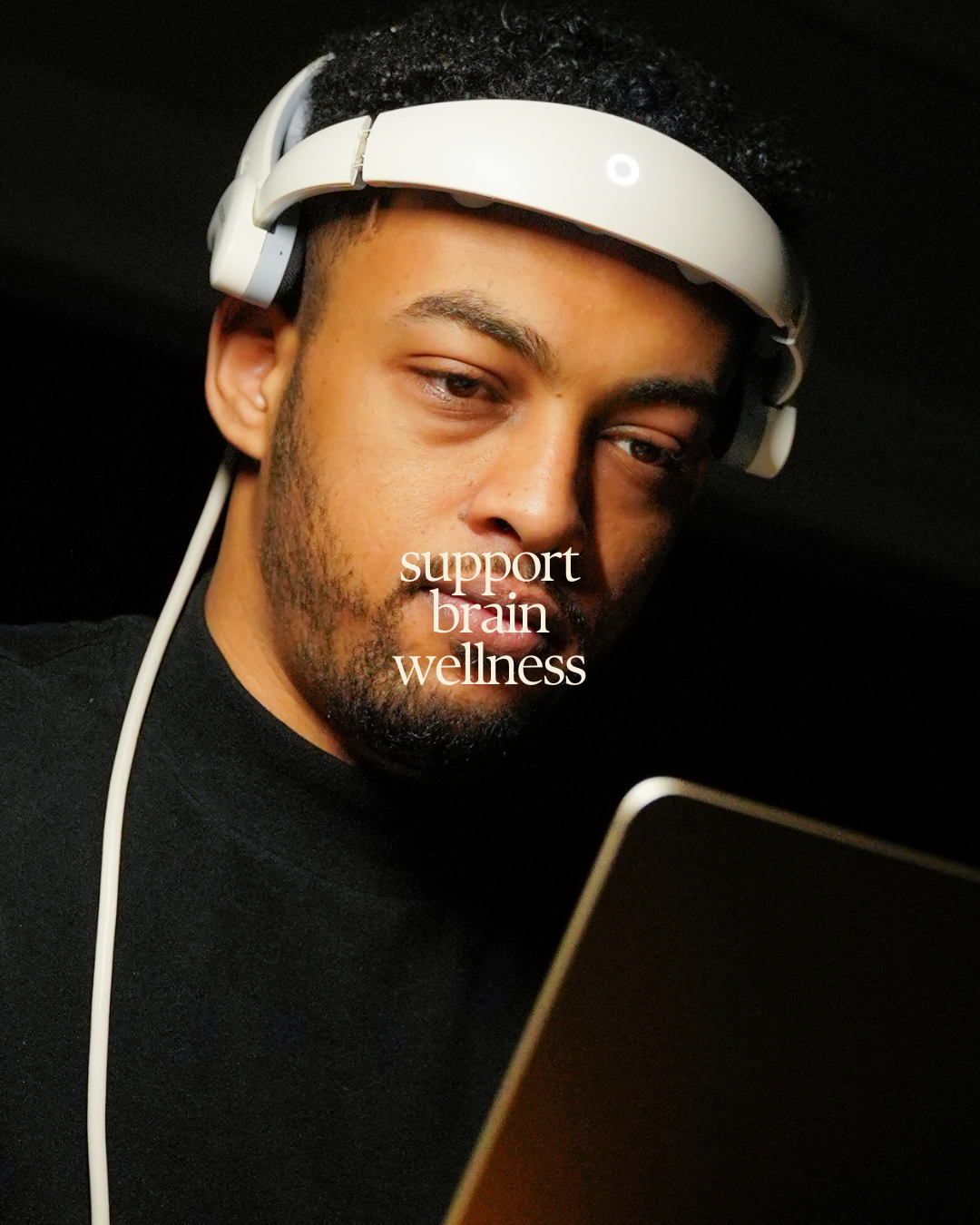
Light → Oscillations → Cognition: Four Steps to “Upgrade” the Brain
In simple terms, specific light stimulation can influence brain activity patterns, helping neural signals become more organized and potentially supporting better cognitive performance. The process can be understood in four steps.
At its core, the approach uses gamma pulse light (around 40 Hz) to stimulate certain neural circuits in the brain. This may activate interneurons and support mitochondrial energy production (ATP), helping neurons communicate more efficiently. As neural signaling becomes more stable and coordinated, cognitive functions such as attention, focus, and memory may improve.

Step 1: Millisecond-Level Activation — Synchronizing Neural Activity
The process begins with the activation of specific interneurons in the brain, particularly PV+ basket cells, which play an important role in regulating neural timing. Research suggests that near-infrared light around 810 nm may influence ion channels such as Nav1.1, increasing the firing activity of these interneurons. These cells release GABA, a neurotransmitter that helps coordinate the activity of nearby pyramidal neurons. As a result, neural signaling becomes more synchronized, producing rhythmic activity around 40 Hz gamma oscillations, which are associated with attention and information processing. This synchronization helps stabilize neural firing patterns and supports more efficient communication between brain cells.
Step 2: Supporting Working Memory Capacity
Light stimulation may also influence rhythmic interactions within the prefrontal cortex, a key region for working memory and executive function. Gamma oscillations in the 40–80 Hz range can interact with slower theta rhythms (4–8 Hz) through a process known as phase–amplitude coupling, which plays an important role in memory processing. When these brain rhythms become more coordinated, neural networks involved in working memory may operate more efficiently.
In addition, the hippocampus, often described as the brain’s memory processing center, may exhibit increased synchronized neural activity known as ripple events. These events are thought to help consolidate information and organize spatial memory, supporting tasks such as navigation, recall, and learning.

Step 3: “Programming” the Synapse — Making Neural Connections More Flexible
Optimizing the “rules of memory formation”
Connections between neurons (synapses) follow a principle called Spike-Timing-Dependent Plasticity (STDP). In simple terms:
- If the presynaptic neuron fires first and the postsynaptic neuron activates shortly after, the connection becomes stronger.
- If the order is reversed, the connection becomes weaker.
Pulsed light at 40 Hz can compress this timing window to about ±15 ms, making the strengthening or weakening of synapses more precise. This improves memory encoding: strong connections store useful information, while weak connections help eliminate noise or irrelevant signals.
Smarter dendrites
Dendrites—the signal-receiving branches of neurons—can also become more efficient. Increased mitochondrial activity produces more ATP, and the density of voltage-gated ion channels may increase. This allows a single dendritic spine to perform logic-like operations such as AND / OR, functioning like a tiny processor within the brain.
In addition, light pulses can activate the c-fos gene, which is associated with neuronal activity. This activation helps newly formed dendritic spines survive longer—some reports suggest survival rates may increase significantly—essentially adding new “wiring” to the neural network.

Step 4: Whole-Brain Coordination — Making the Brain Run More Efficiently
Turning off “useless background processes”
The brain has a system called the Default Mode Network (DMN). When the mind is idle, this network becomes active and is associated with mind-wandering, self-reflection, or thinking about the past. These processes can consume a lot of cognitive resources.
Some theories suggest that 40 Hz light stimulation can reduce activity in the DMN. The idea is that by lowering this background activity, more neural resources become available for focused tasks—similar to closing background apps on a phone to free up processing power and improve attention.
Resetting the “thalamus–cortex rhythm”
The Thalamus acts as a major relay station for signals traveling to the Cerebral Cortex. Within it, the Thalamic Reticular Nucleus helps regulate rhythmic activity in the brain.
Light-induced neural stimulation is proposed to influence this system, helping neurons switch more flexibly between burst firing and quiet states. This may promote the appearance of Sleep Spindles, rhythmic brain waves that occur during sleep and are associated with memory consolidation.
In theory, stronger spindle activity during sleep could help the brain better organize and store memories from the day.
Summary: How Light Is Supposed to “Upgrade” the Brain
The core idea is precise resonance.
By using light at specific frequencies—especially around 40 Hz gamma rhythms—researchers aim to synchronize activity across:
- ion channels in neurons
- neural networks
- synaptic connections
When these systems become more synchronized, neural signaling may become more efficient. In simplified terms, the concept is similar to tuning an orchestra, turning chaotic neural activity into coordinated patterns that process information more effectively.
In popular descriptions, this is sometimes compared to giving the brain a “biophotonic boost”—potentially improving processing speed, memory, and attention.


Partager:
The Penetration Challenge — Why Can’t Light Easily Reach the Brain, and How Are Scientists Solving It?