
810nm Near-Infrared Light
A wavelength range widely studied in PBM and brain-focused light research.
PREMIÈRE FOIS ?
Abonnez-vous à notre newsletter et soyez le premier à être informé de nos nouveautés, promotions spéciales et offres exclusives en ligne.

Photobiomodulation (PBM) studies how specific wavelengths of light interact with biological tissue without relying on heat.
When applied toward the head, this area is often discussed as transcranial photobiomodulation (tPBM).
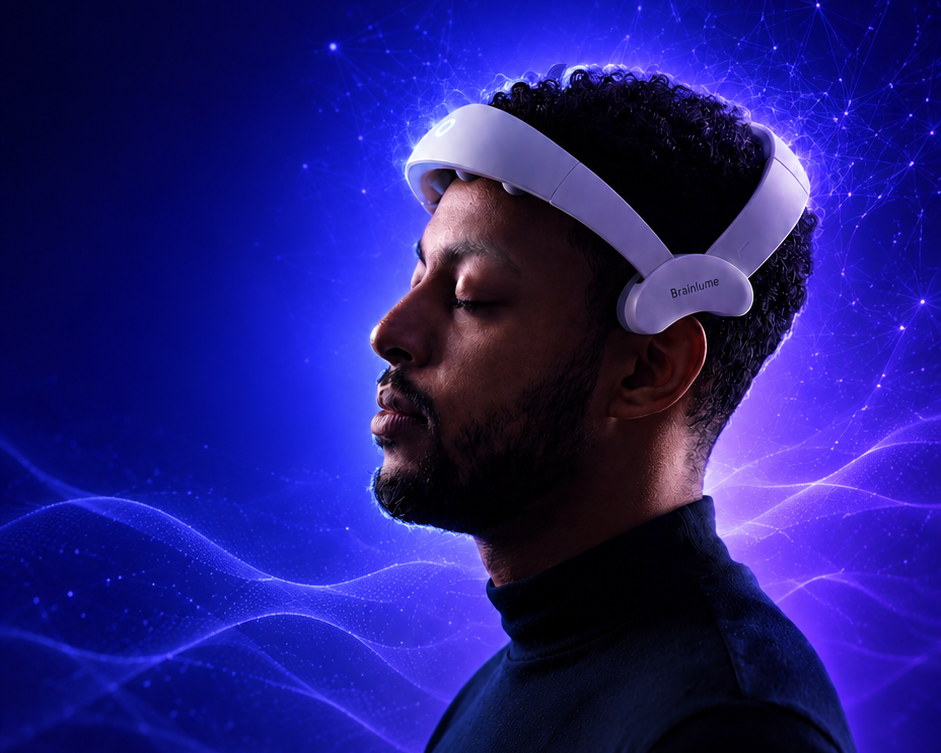
Brainlume translates this research direction into a wearable wellness device through four design choices.
A wavelength range widely studied in PBM and brain-focused light research.
Designed for transcranial, non-invasive light delivery.
Uses gentle, non-heating light without stimulation or heat.
Selectable pulse frequencies commonly discussed in relation to alpha and gamma rhythms.
Near-infrared light around 810nm is widely used in photobiomodulation research because it sits in a wavelength range studied for deeper tissue interaction compared with visible red light.
In PBM literature, this range is often discussed in relation to mitochondrial enzymes, oxygen metabolism, nitric oxide signaling, and cellular energy pathways.
Brain wellness is increasingly viewed through a broader lens that includes sleep, stress load, daily rhythms, recovery habits, and cellular energy — not one pathway alone.
Mitochondria help cells produce and manage usable energy through ATP-related processes. In photobiomodulation research, near-infrared light is studied for its interaction with mitochondrial function, oxygen use, and cellular energy pathways.
Brainlume’s 810nm near-infrared light design is informed by this broader scientific context, while remaining focused on everyday wellness routines.
Sleep, stress load, screen-heavy days, and recovery habits can all influence how the brain uses and manages energy.
Mitochondria help cells produce usable energy through ATP-related processes, making them an important focus in brain wellness and PBM research.
Near-infrared light is studied in PBM research for its interaction with mitochondrial function, oxygen use, and cellular energy pathways.
We believe in transparency. Here is how key design elements relate to the science.
| Design Element | Why It Matters Scientifically | Our Parameters |
|---|---|---|
| 810nm Near-infrared Light | A wavelength range commonly studied in PBM and brain-focused light research. | 810nm ± 10nm |
| Approx. 140 mW/cm² at Scalp | Provides transparency around light intensity at the delivery surface. | ~140 mW/cm² |
| Approx. 168 J/cm² per 20-min Session | Shows the delivered light dose over a standard session. | ~168 J/cm² |
| 10Hz / 40Hz Pulse Modes | Reflects frequencies often discussed in relation to alpha and gamma rhythms. | 10Hz / 40Hz |
| Head-Worn Format | Supports non-invasive transcranial light delivery in a daily-use format. | Wearable Headset |
| Low-Sensation, Non-Thermal Design | Aligns with PBM's non-heating mechanism rather than heat or strong stimulation. | Non-thermal |
A wavelength range commonly studied in PBM and brain-focused light research.
Provides transparency around light intensity at the delivery surface.
Shows the delivered light dose over a standard session.
Reflects frequencies often discussed in relation to alpha and gamma rhythms.
Supports non-invasive transcranial light delivery in a daily-use format.
Aligns with PBM's non-heating mechanism rather than heat or strong stimulation.
Parameters are shown for design transparency and are not medical or therapeutic outcome claims.
Why it matters: This study used 810nm near-infrared LED light on the forehead and measured frequency-related responses using EEG. It is one of the closer references for understanding Brainlume's wavelength and pulse-frequency design logic.
Evidence boundary: This study was not conducted on Brainlume and should not be interpreted as proof of a specific wellness result.
View StudyWhy it matters: This study explored how wavelength and forehead location may influence prefrontal brain responses. It helps support the idea that wavelength, placement, and delivery area matter in brain-focused PBM design.
Evidence boundary: This study used 800nm and 850nm light, not Brainlume's exact 810nm design. It supports the broader wavelength and placement rationale, not a direct Brainlume product claim.
View StudyWhy it matters: This study examined repeated LED-based tPBM and EEG network measures in healthy adults. It is useful for explaining why PBM is often studied as a repeated routine rather than a one-time strong sensation.
Evidence boundary: This study supports the broader research direction of repeated tPBM use. It does not guarantee that every Brainlume user will experience the same outcome.
View StudyWhy it matters: This review summarizes how brain-focused photobiomodulation has been discussed in relation to mitochondria, blood flow, inflammatory pathways, and neurobiological mechanisms.
Evidence boundary: This is a broad review, not a Brainlume product study. It should be used to explain scientific background, not to promise a specific user result.
View StudyWhy it matters: This study measured cytochrome-c-oxidase and hemodynamic responses, helping explain why PBM is often discussed in relation to mitochondrial activity, oxygen use, and brain-level physiological measures.
Evidence boundary: This study used 1064nm infrared laser stimulation, not Brainlume's 810nm wearable design. It is relevant as mechanism-direction evidence, not as direct Brainlume proof.
View StudyWhy it matters: This study explored mitochondrial oxidative metabolism and cerebrovascular responses in younger and older healthy adults, supporting the idea that tPBM-related effects may be studied through physiological markers rather than immediate sensation.
Evidence boundary: This was not an 810nm Brainlume study. It should be presented as broader human mechanism evidence with wavelength and device differences clearly noted.
View StudyWhy it matters: This systematic review summarizes human tPBM studies related to cognitive function. It is useful for showing that brain-focused PBM has been studied across human research settings.
Evidence boundary: This review includes different populations, wavelengths, devices, and study designs. It should not be read as a Brainlume-specific clinical claim or a guarantee of cognitive improvement.
View StudyWhy it matters: This review summarizes human brain-activity research involving tPBM, including measures such as EEG, fNIRS, and related neurophysiological indicators.
Evidence boundary: This review supports the broader scientific basis for studying brain activity under tPBM. It does not prove that Brainlume produces a specific effect for every user.
View StudyWhy it matters: This overview provides a broader neuroscience background for brain photobiomodulation, including mechanisms, study directions, and research context.
Evidence boundary: This is a field overview, not a consumer wellness product study. Any disease-related discussion should not be translated into Brainlume marketing claims.
View StudyThese references are provided for educational purposes. Unless clearly stated, they were not conducted on Brainlume. Individual experiences may vary.

See how Brainlume works in everyday routines, or view the product details before you choose.