


Light Delivery
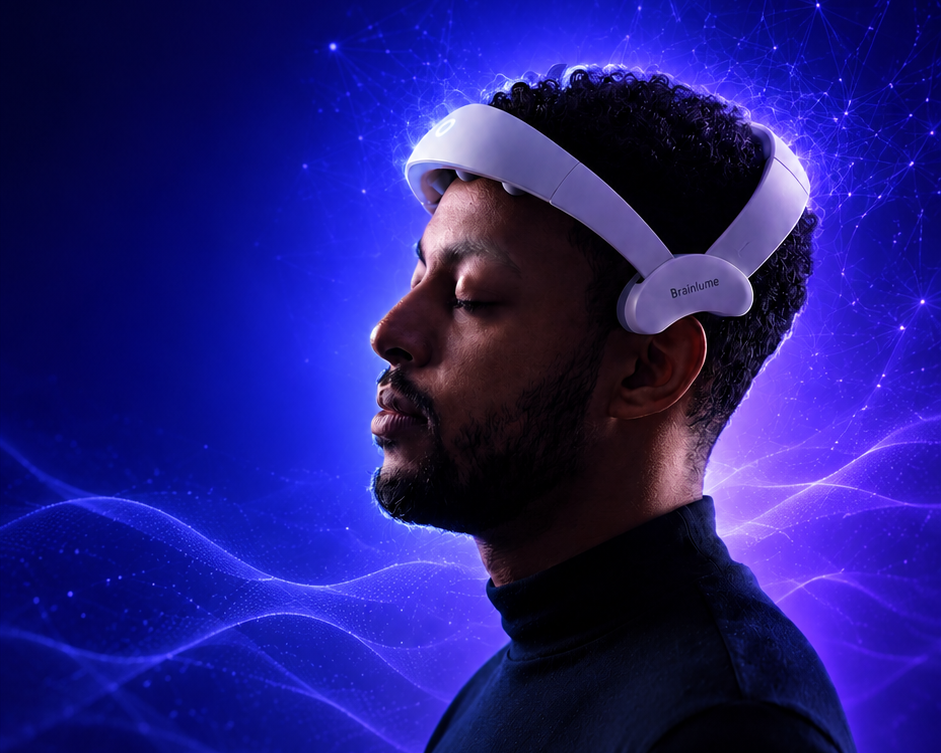
Six windows direct pulsed 810nm light toward the scalp. A portion can pass through the scalp and skull, with light intensity decreasing as it travels through tissue.

Sign up and save on your first Brainlume order.

THE SCIENCE BEHIND BRAINLUME
tPBM stands for transcranial photobiomodulation.
It is a light-based approach studied for how near-infrared light interacts with the head and cellular energy processes, without heat or strong stimulation.
Uses specific wavelengths of near-infrared light.
Light is designed to pass through the scalp and skull.
Studied for how light interacts with cellular energy pathways.
Operates in a low-sensation, non-thermal range.
LIGHT · CELLS · ENERGY
From light delivery to cellular energy and signaling—the research rationale behind photobiomodulation.
Six windows direct pulsed 810nm light toward the scalp. A portion can pass through the scalp and skull, with light intensity decreasing as it travels through tissue.
PBM research examines how light interacts with cytochrome c oxidase and other pathways associated with mitochondrial function.

These interactions are studied in relation to ATP production, oxygen use, nitric oxide signaling and downstream cellular responses.

WHAT A SESSION FEELS LIKE
You may feel little or no sensation during a session. Some users notice mild warmth near the light windows. Both experiences can be normal.
Sensation alone does not indicate light output or individual results. Track how Brainlume fits into your routine over time.

Time to wind down
Sleep continuity
Next-day clarity
Afternoon fatigue
Focus after daytime sessions
Overall calmness
CHOOSE YOUR RHYTHM
Choose 40Hz Gamma for daytime clarity or 10Hz Alpha for evening wind-down.
The optical output stays the same. Only the pulse frequency changes.
TIMED FOR CONSISTENCY
Consistent light delivery. Built for your daily rhythm.
QUESTIONS, ANSWERED
Understand the light, choose your mode, and know what to expect.
Transcranial photobiomodulation (tPBM) applies red or near-infrared light to the head and is studied for its effects on cellular activity and brain function. Brainlume uses 810nm near-infrared light for daily brain wellness sessions.
Brainlume delivers near-infrared light through six light windows using 10Hz or 40Hz pulses at a 50% duty cycle. Each window provides approximately 180 mW peak optical output and 90 mW time-averaged output.
You may notice mild warmth or very little sensation. A strong sensation is not required for light delivery, and how a session feels does not indicate the amount of light reaching brain tissue.
Choose 40Hz Day Mode (Gamma) for daytime focus and mental recharge, or 10Hz Night Mode (Alpha) for evening wind-down. Both modes use the same wavelength, optical output, and 20-minute session duration. Only the pulse frequency changes.
A preset duration keeps each full session consistent and easy to repeat. At Brainlume’s defined optical output, 20 minutes corresponds to a calculated exposure of approximately 103.8 J/cm² per window at the light-delivery surface.A preset duration keeps each full session consistent and easy to repeat. At Brainlume’s defined optical output, 20 minutes corresponds to a calculated exposure of approximately 103.8 J/cm² per window at the light-delivery surface.
Brainlume is designed for general brain wellness. It is not intended to diagnose, treat, cure, or prevent disease.