
810nm NIR
A near-infrared wavelength used in research on light transmission and cellular energy.
Sign up and save on your first Brainlume order.

RESEARCH TO DESIGN
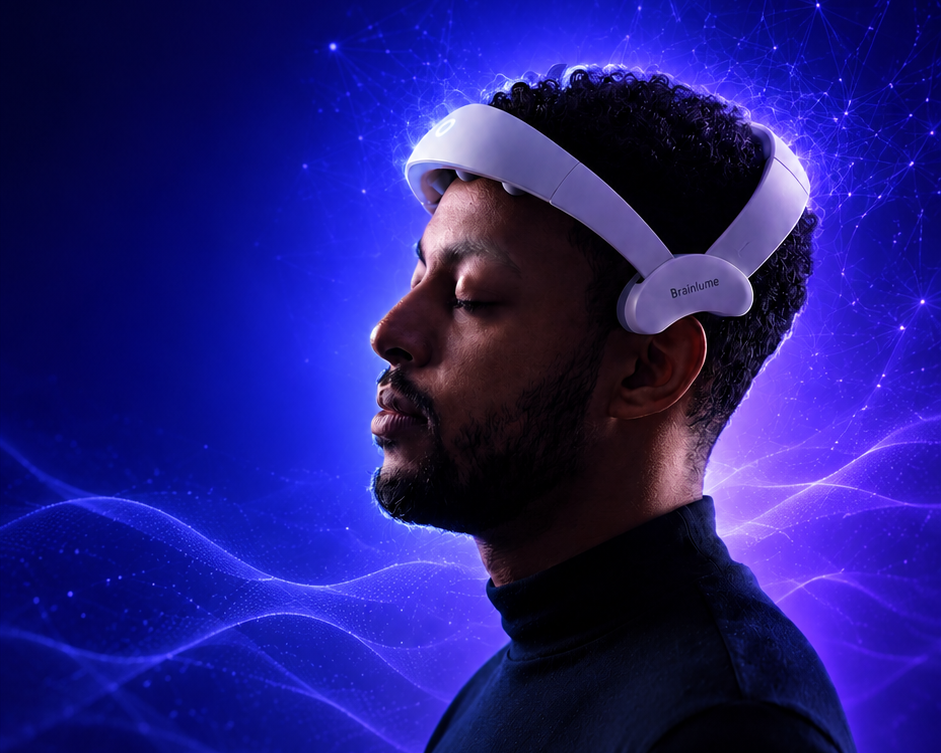
Brainlume applies principles from transcranial photobiomodulation (tPBM) research through four connected design choices.
A near-infrared wavelength used in research on light transmission and cellular energy.
Six light windows direct near-infrared light toward the scalp.
Light delivery based on photobiological processes rather than tissue heating.
Two pulse frequencies, both operating at a 50% duty cycle.
WAVELENGTH & LIGHT DELIVERY
810nm near-infrared light is used in tPBM research to study light transmission through head tissues and interactions with cellular energy pathways.
Only a portion of surface light passes through scalp and skull. Transmission depends on tissue and delivery conditions.
CELLULAR ENERGY RESEARCH
Mitochondria produce usable cellular energy through ATP-related processes. Photobiomodulation research examines how near-infrared light interacts with cytochrome c oxidase and other pathways involved in mitochondrial function.
Researchers also study oxygen use, nitric oxide signaling and hemodynamic responses. These connected processes help explain the scientific rationale for brain-focused light delivery.
Studies examine cytochrome c oxidase and other pathways associated with mitochondrial function.
Researchers measure energy metabolism and oxygen use to investigate responses to light.
NO-related signaling and hemodynamics are additional areas of PBM research.
OPTICAL DESIGN & DOSIMETRY
Explore the wavelength, pulse settings and optical dose behind Brainlume.
| Parameter | Why It Matters | Our Specification |
|---|---|---|
| Wavelength | Identifies the near-infrared wavelength used by the LEDs. | 810nm ± 5nm |
| Pulse Settings | Defines pulse frequency and the proportion of each cycle with the LEDs ON. | 10Hz / 40Hz50% duty cycle |
| Output / Window | Distinguishes peak optical power from average power over a full pulse cycle. | Peak ≈180mWAvg. ≈90mW |
| Spot Size | Defines the area used to calculate irradiance and exposure. | Diameter ≈11.5mmArea ≈1.04cm² |
| Irradiance | Expresses optical power per unit area at the light-delivery surface. | Avg. ≈86.5mW/cm²Peak ≈173mW/cm² |
| Exposure / Window | Expresses optical energy per unit area over a 20-minute session. | ≈103.8J/cm² in 20 minutes |
Values describe emitted light at the delivery windows. Average values include the full pulse cycle; exposure is calculated per window over 20 minutes.
Parameters are shown for design transparency and are not medical or therapeutic outcome claims.
EXPLORE THE EVIDENCE
These independent studies explore PBM mechanisms and human responses.
An 810nm LED study compared forehead illumination at different pulse frequencies and measured changes in EEG activity.
Tested 0, 5, 10 and 20Hz; the protocol did not test 40Hz.
Full title: Effects of stimulating frequency of NIR LEDs light irradiation on forehead as quantified by EEG measurements
Study context: This study was not conducted on Brainlume and should not be interpreted as proof of a specific wellness result.
Researchers compared wavelengths and forehead sites using near-infrared spectroscopy to assess prefrontal connectivity and coupling.
Used 800/850nm lasers and different delivery conditions from Brainlume.
Full title: Site-specific effects of 800- and 850-nm forehead transcranial photobiomodulation on prefrontal bilateral connectivity and unilateral coupling in young adults
Study context: This study used 800nm and 850nm light, not Brainlume's exact 810nm design. It supports the broader wavelength and placement rationale, not a direct Brainlume product claim.
Repeated LED-based tPBM was studied in healthy adults using vigilance performance and EEG network measures.
Independent LED device and repeated-use protocol; results are not Brainlume-specific.
Full title: Repeated Transcranial Photobiomodulation with Light-Emitting Diodes Improves Psychomotor Vigilance and EEG Networks of the Human Brain
Study context: This study supports the broader research direction of repeated tPBM use. It does not guarantee that every Brainlume user will experience the same outcome.
A narrative review of mitochondrial, vascular and other biological pathways investigated in brain photobiomodulation.
Reviews multiple experimental models and devices, rather than a Brainlume product study.
Full title: Brain Photobiomodulation Therapy: a Narrative Review
Study context: This is a broad review, not a Brainlume product study. It should be used to explain scientific background, not to promise a specific user result.
Broadband NIRS measured cytochrome-c-oxidase and hemodynamic responses during transcranial infrared laser stimulation.
Used a 1064nm laser, not Brainlume’s 810nm LED design.
Full title: Up-regulation of cerebral cytochrome-c-oxidase and hemodynamics by transcranial infrared laser stimulation: A broadband near-infrared spectroscopy study
Study context: This study used 1064nm infrared laser stimulation, not Brainlume's 810nm wearable design. It is relevant as mechanism-direction evidence, not as direct Brainlume proof.
Researchers studied mitochondrial and cerebrovascular responses to infrared laser stimulation in younger and older healthy adults.
A human mechanism study using a 1064nm laser and a separate delivery protocol.
Full title: Transcranial laser stimulation: Mitochondrial and cerebrovascular effects in younger and older healthy adults
Study context: This was not an 810nm Brainlume study. It should be presented as broader human mechanism evidence with wavelength and device differences clearly noted.
A systematic review of human tPBM studies covering learning, memory, attention and other cognitive measures.
Includes varied populations, wavelengths, devices and study protocols.
Full title: Can transcranial photobiomodulation improve cognitive function? A systematic review of human studies
Study context: This review includes different populations, wavelengths, devices, and study designs. It should not be read as a Brainlume-specific clinical claim or a guarantee of cognitive improvement.
A systematic review of human brain-activity findings measured with EEG and other neurophysiological methods.
Summarizes the research field; it does not validate a specific Brainlume outcome.
Full title: A systematic review of the effects of transcranial photobiomodulation on brain activity in humans
Study context: This review supports the broader scientific basis for studying brain activity under tPBM. It does not prove that Brainlume produces a specific effect for every user.
An edited reference book covering brain PBM mechanisms, experimental methods and research across neuroscience.
A 2019 academic book, rather than a 2021 journal article or Brainlume trial.
Full title: Photobiomodulation in the Brain: Low-Level Laser (Light) Therapy in Neurology and Neuroscience
Study context: This is a field overview, not a consumer wellness product study. Any disease-related discussion should not be translated into Brainlume marketing claims.
These references are provided for educational purposes. Individual experiences may vary.

Explore Brainlume’s 810nm headset and build your daily light routine.