
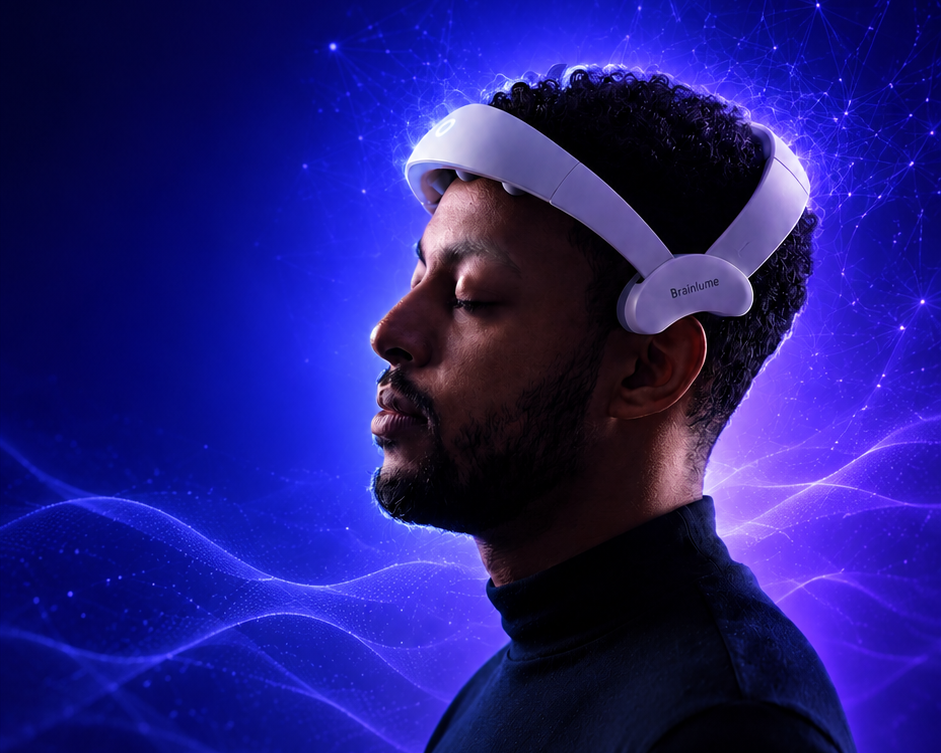
If a light session lasts 20 minutes, would 40 minutes work twice as well? If one device delivers more power, should you expect better results?
These are natural questions when exploring photobiomodulation, or PBM. We often associate a bigger number with better performance.
But a biological response does not necessarily increase in step with the amount of light delivered. In PBM, understanding the dose matters more than simply increasing it.

A response that can rise and fall
Researchers use the term biphasic dose response to describe a pattern in which a response increases over a range of exposures, then diminishes or changes direction as exposure rises further.
In some PBM experiments, a lower exposure produces a more favorable response than a higher one. This pattern is often illustrated as an inverted U-shaped curve: increasing exposure can help up to a point, after which additional light may reduce the desired effect. [1]
This does not mean the smallest dose is always best. An exposure can also be too low to produce a measurable response. The useful range depends on the conditions being studied, including the tissue, light delivery, and outcome measured.
A conceptual curve helps explain the principle. It cannot identify one ideal dose for every person or device.
How cells respond to light
PBM research examines how absorbed light influences cellular processes, including mitochondrial activity and ATP production. ATP is a molecule cells use to power many of their functions.
In a 2011 experiment, researchers exposed cultured mouse cortical neurons to several doses of 810nm laser light. ATP and mitochondrial membrane potential increased at lower exposures and decreased at higher exposures. Cellular signaling molecules also showed changes that depended on dose. [2]
These findings help explain why adding more light may change a response rather than simply amplify it.
The experiment involved cells in a laboratory. Its dose values are not instructions for a wearable: directly illuminated cells and light delivered through the scalp and skull have very different exposure conditions.
Why one energy number is not enough
Optical power describes how quickly light energy is emitted. Session duration determines how long that delivery continues. At a constant optical output, doubling the duration doubles the emitted energy.
That calculation does not establish a proportional biological benefit.
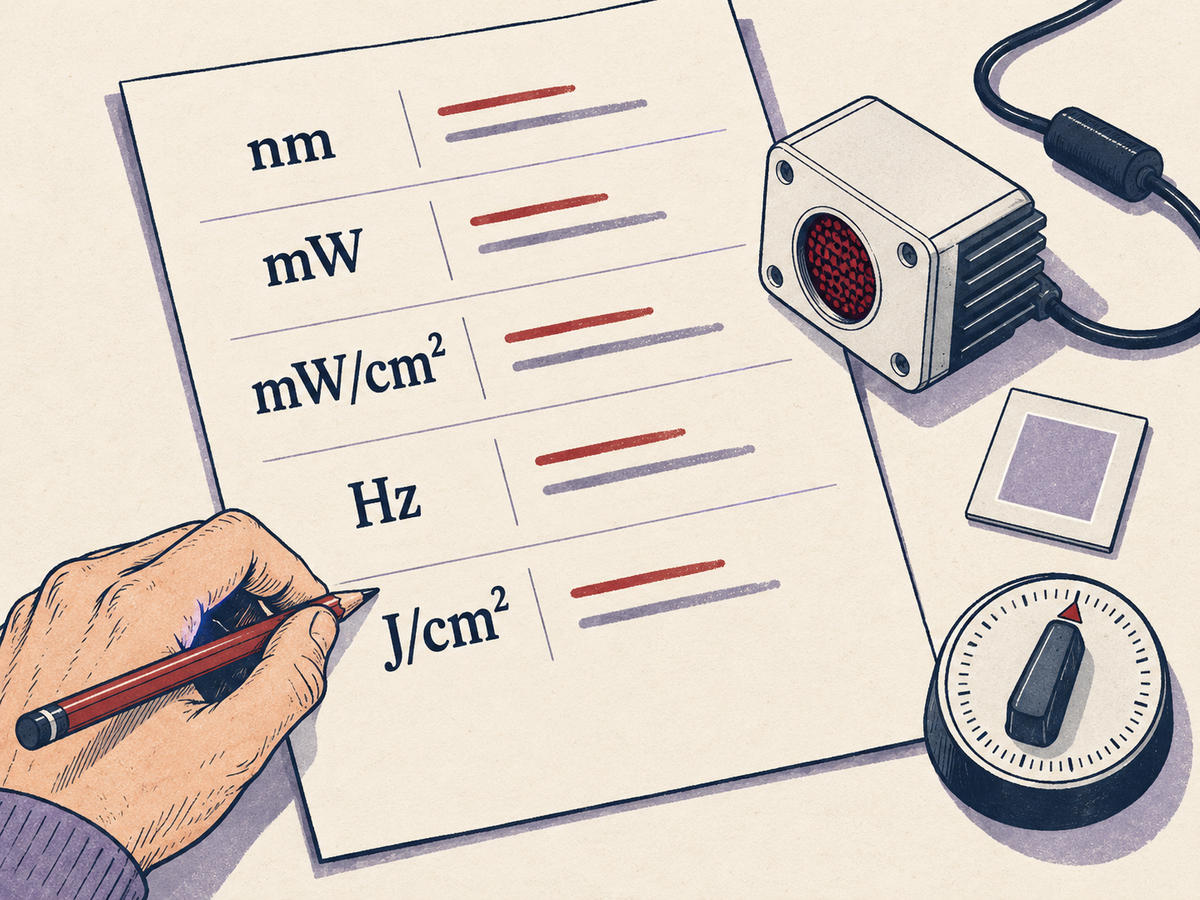
Light delivery also involves wavelength, illuminated area, irradiance, and pulse structure. Irradiance describes power per unit area, while radiant exposure describes energy per unit area accumulated over time. A total-energy figure alone leaves much of that picture out. [3]
For pulsed light, peak output and time-averaged output also need to be distinguished. And a specification measured at a device's light-delivery surface does not tell you exactly how much light reaches a particular brain region. Hair, positioning, and individual anatomy influence that journey. [4]
For a closer look at these units, read Wavelength, Power, and Dose: Understanding PBM Specs.

More sessions do not guarantee more benefit
The number and timing of sessions are another part of a PBM protocol.
A 2016 study in mice with traumatic brain injury compared three daily applications of 810nm laser light with fourteen daily applications. The shorter course produced better results on several measured outcomes; extending the course did not simply add to its benefits. [5]
This was an animal injury study, so it does not establish a schedule for healthy adults. It illustrates why researchers examine repeated exposure instead of assuming that more sessions will always work better.
What this means for your Brainlume routine
Brainlume uses 810nm LEDs with a preset 20-minute session and automatic shutoff. Its 10Hz and 40Hz modes share the same optical output and 50% duty cycle. The higher pulse frequency does not deliver four times the energy over the same session. [4]
The preset duration gives each full session a consistent structure. It should not be interpreted as proof that 20 minutes is a universal biological optimum.
Follow the current user instructions when choosing session length and frequency. Avoid extending or stacking sessions simply to chase a stronger result.
A strong sensation is not a measure of effectiveness. Mild warmth—or very little sensation—does not reveal the amount of light reaching brain tissue. If you experience discomfort or an unusual reaction, stop the session and contact support. [4]
Look for thoughtful light delivery
Understanding the biphasic response gives you a better way to evaluate a PBM device: consider its clearly reported output, delivery method, and use instructions together.
A well-explained routine helps you understand what the device delivers and how to use it consistently. The goal is an appropriate exposure for the intended use, rather than the largest energy number.
Explore Brainlume and its daily light routine.
References
- Huang YY, Chen AC-H, Carroll JD, Hamblin MR. Biphasic Dose Response in Low Level Light Therapy. Dose Response. 2009;7(4):358–383. DOI.
- Sharma SK, Kharkwal GB, Sajo M, et al. Dose Response Effects of 810 nm Laser Light on Mouse Primary Cortical Neurons. Lasers in Surgery and Medicine. 2011;43(8):851–859. DOI. PubMed.
- Hadis MA, Zainal SA, Holder MJ, et al. The dark art of light measurement: accurate radiometry for low-level light therapy. Lasers in Medical Science. 2016;31:789–809. DOI.
- Brainlume. FAQ and How It Works. Product specifications and guidance checked October 22, 2026.
- Xuan W, Huang L, Hamblin MR. Repeated transcranial low-level laser therapy for traumatic brain injury in mice: biphasic dose response and long-term treatment outcome. Journal of Biophotonics. 2016;9(11–12):1263–1272. DOI. Full text.

Share:
Wavelength, Power, and Dose: Understanding PBM Specs